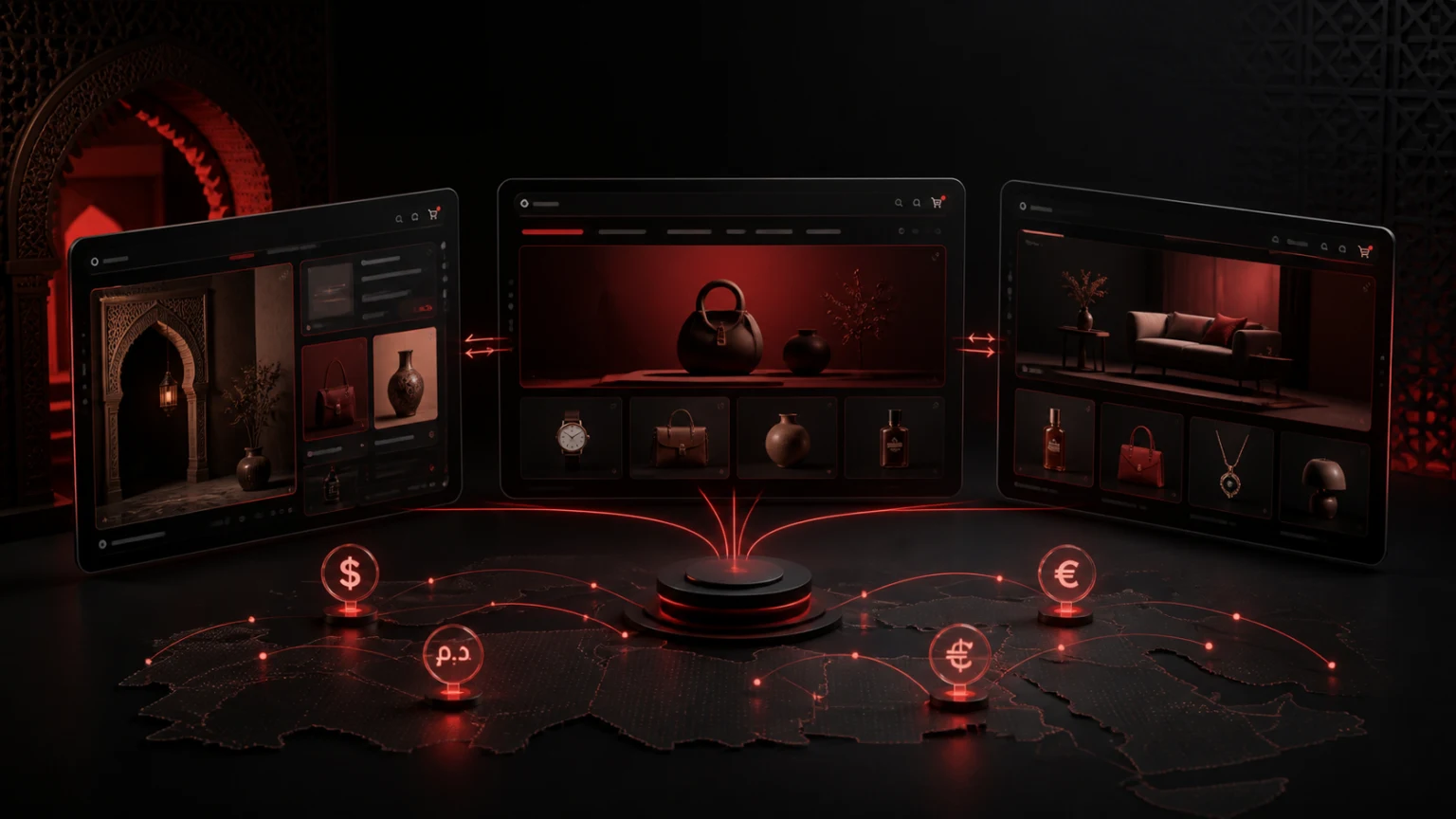
Architecting an e-commerce platform for North African markets—specifically Morocco, Algeria, and Tunisia—presents unique technical and cultural challenges. Online shoppers in the Maghreb fluidly move between Modern Standard Arabic (MSA), localized dialects such as Darija, and French. Additionally, cross-border financial regulations and local payment preferences mean that currency routing cannot be handled through simple auto-conversions. Designing a reliable backend architecture requires a structural approach to URL hierarchies, hreflang annotations, content localized by use-case, and dynamic currency switching.
1. Structuring URL Taxonomies and Hreflang Annotations
The foundational decision in a multi-regional, multi-lingual build is URL architecture. Subdirectory structures—such as /ma/ar/ for Arabic in Morocco or /ma/fr/ for French in Morocco—are generally preferred over country-code top-level domains (ccTLDs). Subdirectories preserve domain authority on a single root domain while lowering infrastructure management costs and SSL certificate overhead.
Correct implementation of hreflang attributes is critical to prevent duplicate content penalties and ensure search engines serve the correct regional variant. Annotations must explicitly define both language and region (for example, hreflang="ar-MA" and hreflang="fr-MA"). An hreflang="x-default" tag should target a landing page or region-selector modal for unmapped IP locations. Search crawlers rely on these signals to differentiate between similar content localized for different North African markets.
2. Content Localization Strategy: Darija, MSA, and French
Managing three distinct linguistic layers requires assigning clear operational roles to each language across the customer journey:
- Darija (Local Dialect): Highly effective for microcopy, call-to-action buttons, promotional banners, and customer support interfaces. It builds immediate trust and emotional resonance, though search query volume for written Darija varies.
- Modern Standard Arabic (MSA): Essential for comprehensive product descriptions, category pages, terms of service, and search engine indexation across the broader Arab world.
- French: Commonly expected for technical specifications, B2B product catalogs, invoice generation, and checkout flows due to established banking and commercial habits in the region.
Architecturally, fallback logic must be defined. If a product description is unavailable in regional Darija, the system should gracefully default to MSA or French without generating empty content blocks or broken page layouts.
3. Currency Routing and Payment Gateway Integration
Handling local currencies—such as Moroccan Dirham (MAD), Algerian Dinar (DZD), and Tunisian Dinar (TND)—alongside foreign currencies (EUR or USD) demands flexible data modeling. Rather than relying on live, automated conversion rates that fluctuate daily, North African e-commerce sites often set static regional price points to account for localized logistics, import duties, and transaction fees.
IP-based geolocation should only serve as an initial recommendation. Forcing automated redirects based on visitor IP can trap search engine bots—such as Googlebot, which primarily crawls from US-based IPs—in incorrect geographic loops, preventing them from indexing localized North African pages. Currency and country preferences should be stored in user session states or cookies, leaving the underlying target URL stable and accessible.
4. Architectural Trade-Offs and Performance Measurement
Building a complex, multi-lingual infrastructure involves clear trade-offs. Storing multiple translations and currency tables increases database complexity and cache invalidation overhead. Content teams face higher operational workloads maintaining multiple catalog versions.
To evaluate the technical health and user experience of your architecture, monitor objective operational metrics rather than relying on performance assumptions:
- Indexation Accuracy: Check Google Search Console to verify that hreflang tags are validated without missing return tags.
- Bounce Rate by Locale: Identify whether users arriving on specific language versions abandon pages due to poor translation or incorrect default language selection.
- Checkout Conversion Rate per Currency: Measure drop-off rates at payment steps across local versus international currencies.
- Core Web Vitals Impact: Ensure localized fonts (such as Arabic script web fonts) and internationalization scripts do not degrade page loading performance.
Implementation Checklist
- Define URL structure using clear subdirectories (e.g.,
/ma/ar/, /ma/fr/). - Implement self-referencing and reciprocal
hreflang tags across all language pairs. - Establish clear rules for when to use Darija, MSA, and French across the catalog.
- Configure non-coercive currency routing that respects user choice and bot crawling.
- Integrate local payment gateways mapped to their respective regional currencies.
If you are planning to engineer a multi-lingual system suited to regional requirements, review our technical approach through our web development services or reach out to discuss your platform requirements.
Frequently Asked Questions
How should search engines treat Darija content written in Latin characters versus Arabic script?
Latin-script Darija (often used in casual messaging) lacks standardized spelling, making it difficult for search engine indexing. Standardizing on Arabic script for on-site Darija copy provides better consistency and visual alignment with standard Arabic layouts.
Why should currency selection be decoupled from language selection?
Users in North Africa may prefer reading product details in French while paying in local currency (MAD, DZD, TND), or vice versa. Decoupling language state from currency state ensures flexibility for cross-border buyers and expatriates.
Conclusion
Structuring a successful multi-lingual e-commerce architecture in North Africa requires a balance between technical discipline and regional user habits. By establishing robust hreflang frameworks, sensible content fallbacks across Darija, MSA, and French, and unobtrusive currency routing, engineering teams can deliver scalable platforms adapted to the region's diverse market landscape.
FoxDigia Team
FoxDigia Team specializes in building brand identities, website design, digital marketing, and improving businesses' presence in Morocco and the Gulf.