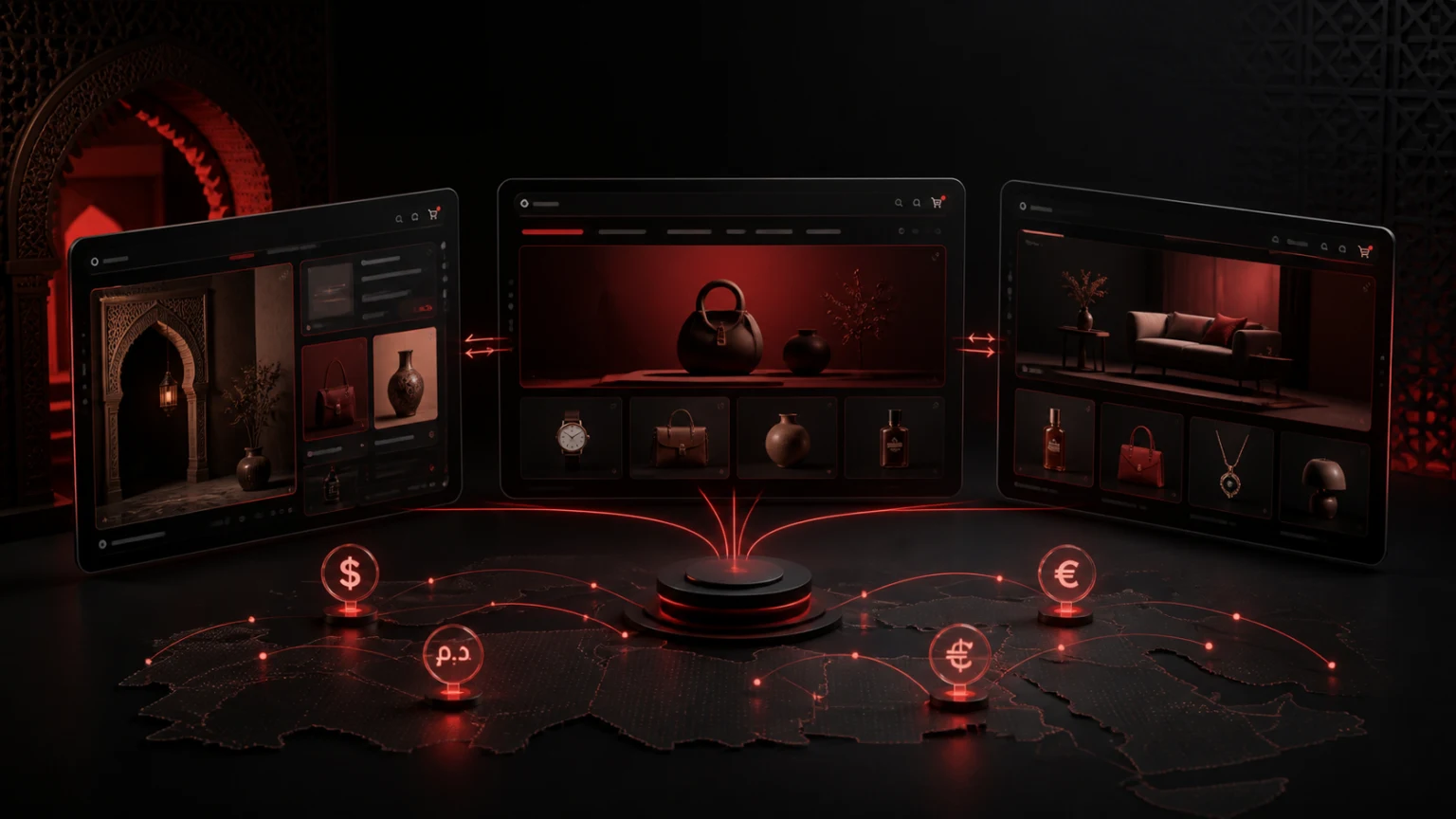
Cross-border digital commerce across North Africa and the Cooperation Council for the Arab States of the Gulf (GCC) presents distinct technical requirements. Businesses targeting both Morocco and GCC markets must cater to audiences requiring Right-to-Left (RTL) Arabic typography and Left-to-Right (LTR) French or English layouts. Furthermore, handling transaction processing across distinct currencies—such as the Moroccan Dirham (MAD), Saudi Riyal (SAR), and UAE Dirham (AED)—demands an adaptable system architecture. Decoupled, or headless, e-commerce provides the structural modularity necessary to handle these localized nuances without compromising overall performance.
Decoupling Frontend and Backend for Regional Flexibility
Headless architecture isolates the user-facing presentation layer from core business logic via application programming interfaces (APIs). By separating frontend frameworks (such as Next.js, Nuxt.js, or Remix) from backend engines (such as Shopify Plus, Commerce Layer, or custom microservices), engineering teams can build specialized, regional user interfaces tailored to local consumer expectations. Backend services continue handling unified inventory, order processing, and fulfillment workflows, while light, edge-rendered frontends deliver fast page loads tailored specifically for Moroccan or Gulf-based consumers.
Managing Multi-Currency Systems: MAD, SAR, AED, and Beyond
Handling multi-currency transactions requires more than simple client-side exchange rate conversion. The Moroccan Dirham operates under a managed float regime influenced by a currency basket, whereas major GCC currencies are pegged directly to the US Dollar. To avoid pricing discrepancies and abandoned checkouts, the architecture should maintain region-specific base price lists within the backend rather than relying solely on dynamic front-end recalculations. Integrating localized payment gateways is equally critical. Incorporating solutions such as CTM or PayZone for Morocco, alongside Tap, PayFort, or Checkout.com for the GCC, ensures buyers complete transactions in their native currency using trusted local payment methods.
Handling Multi-Script Layouts: Seamless RTL and LTR Integration
Supporting multi-script environments involves significant visual and technical adjustments. Designing for Arabic (RTL) alongside French or English (LTR) requires writing layout styles using CSS Logical Properties (e.g., `padding-inline-start` instead of `padding-left`). This approach allows element positioning to mirror dynamically based on the active document direction attribute (`dir="rtl"` or `dir="ltr"`). Furthermore, font management requires careful trade-offs. Complex Arabic web fonts can introduce visual rendering shifts (Cumulative Layout Shift) and additional network payloads if not properly subsetted, self-hosted, and loaded asynchronously.
Data Localization and Regulatory Compliance Across Sub-Regions
Data privacy standards vary significantly between North Africa and the Gulf region. In Morocco, e-commerce operators must align with Law No. 09-08 enforced by the CNDP (Commission Nationale de contrôle de la protection des Données à caractère Personnel). Meanwhile, GCC nations enforce stringent local data sovereignty regulations, such as the UAE’s Personal Data Protection Law and Saudi Arabia’s NDMO frameworks. A microservices-based headless setup allows developers to route personal identifiable information (PII) and payment processing payloads through region-specific edge nodes or compliant local storage providers without fragmenting the core application base.
Implementation Checklist and Architectural Trade-Offs
Executing a scalable multi-regional headless setup requires balancing system performance against operational complexity:
- Select an API-first CMS that natively supports localized content trees and asset management.
- Implement middleware services to manage country-level tax rules, customs calculations, and currency rounding rules.
- Utilize CSS logical properties and automated visual regression testing for RTL/LTR layouts.
- Deploy geolocation routing at the DNS or CDN level to serve appropriate regional frontend instances.
Every architectural choice involves trade-offs. Aggressive edge caching improves global response times but introduces cache invalidation challenges when dynamic prices or stock levels shift rapidly across regions. To explore modular solutions tailored to your technical requirements, explore our web development services or consult with our technical architects.
Frequently Asked Questions
Does a headless architecture increase ongoing engineering overhead?
Yes. Headless implementations require dedicated frontend maintenance, API orchestration, and developer expertise compared to monolithic, template-driven platforms. However, they reduce long-term technical debt when operating across multiple brands or diverse geographic regions.
How should performance and success be measured in multi-currency builds?
Technical success is measured through Core Web Vitals (such as LCP and CLS), API response latency across targeted regions, and business metrics including regional checkout conversion rates and reduced payment drop-off rates.
Conclusion
Architecting a headless e-commerce store capable of serving dual-currency and multi-script demands across Morocco and the GCC provides a resilient foundation for regional expansion. By decoupling presentation layers, handling localized currencies securely, and planning for multi-script rendering, enterprises can deliver localized commerce experiences without sacrificing site performance. When planning your system architecture, feel free to contact our technical team to review your engineering roadmap.
FoxDigia Team
FoxDigia Team specializes in building brand identities, website design, digital marketing, and improving businesses' presence in Morocco and the Gulf.